Life online
Friendships, group chats, social media and making room for life away from screens.
We visit schools and colleges to talk with pupils, parents and staff about life online. A session can cover group chats, sharing photos, gaming or AI. We choose examples and activities with you to suit the group’s age and everyday experiences.

Photos, kind messages and adults who can help.
Pupils practise respecting a no, checking an answer and asking an adult for help.
Look at picture cards and discuss things people can do together on a screen. An adult reads all the text aloud.
Asta wants to share a picture of Noa and their tower. Noa only wants the tower shown. Pupils draw a picture that respects Noa's no.
A prepared AI example says a spider has six legs. The class counts the legs on a fact card and corrects the answer together.
Pupils use action cards with fictional situations and practise asking, saying no and getting an adult in pairs.
Each pupil points to or describes one action from the activities. No one needs to share a personal experience.
After the visit: Spend five minutes on a new picture story later in the week. Let pupils show what they would do and adapt the reading to their stage.
Timings and content are suggestions. Worksheets and teacher notes need no accounts or phones.
Through stories and group activities, children practise asking before sharing, keeping information private and getting help. An adult also introduces simple examples of AI.
Pupils practise asking, saying no and getting help. The teacher receives a simple class discussion activity.
A character receives a message from a stranger. The class chooses what the character can do and which adult can help.
Two classroom activities. Adjust the time to suit your group.
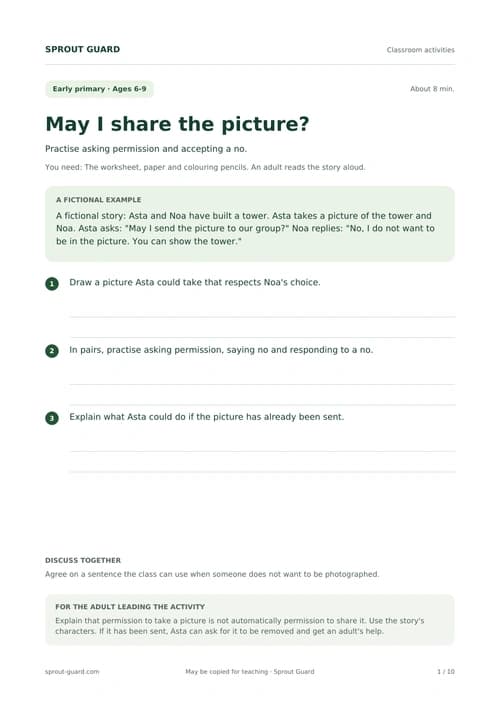
Practise asking permission and accepting a no.
You need: The worksheet, paper and colouring pencils. An adult reads the story aloud.
A fictional story: Asta and Noa have built a tower. Asta takes a picture of the tower and Noa. Asta asks: "May I send the picture to our group?" Noa replies: "No, I do not want to be in the picture. You can show the tower."
Follow up: Agree on a sentence the class can use when someone does not want to be photographed.
Choose what to keep private and who can help.
You need: The worksheet and pencils. Read the messages aloud or act them out with paper characters.
Fictional game messages: Star7 writes to a character called Mio: "You are good! What is your school's name? Send me a picture of you and I will give you a gift. You do not need to tell the adults." Mio only knows Star7 from the game.
Follow up: Practise saying: "I have received a message I need help with."
All five groups. Your activities start on page 1.
Group chats, games, privacy and first encounters with AI answers.
Students practise finding evidence for information and writing a message that helps a classmate.
Discuss where we encounter information and AI answers. Use shared fictional examples rather than private messages.
A fictional class chat leaves Sam out of a game. Students choose a reply that includes Sam without putting someone else down.
Compare a prepared AI answer about a class trip with a teacher's fact card. Find changed, added and omitted information.
Groups correct the AI answer and write a short message for the class chat. They show where their information comes from.
Share the groups' responses. Agree to find the original message before passing information on.
After the visit: Use the question 'Where does it say that?' in the next shared information task. Ask students to point to the source for their answer.
Timings and content are suggestions. Worksheets and teacher notes need no accounts or phones.
We work with messages, online communities and sharing photos. Students practise checking an AI answer against a source and choosing what to keep private. No personal accounts or phones are needed for the activities.
The class makes agreements about messages, photos and getting help. Parents can use these to continue the conversation at home.
Small groups examine a fictional group chat. Who is being left out, and how could a message be rewritten?
Two classroom activities. Adjust the time to suit your group.
Look at how a message excludes someone and write a different reply.
You need: The worksheet chat and paper for a new reply. Work in groups of three.
A fictional class chat: Ella: "Shall we play after school?" Malte: "Yes, but not with Sam. Make a new group without him." Sam: "I can play at four." A third pupil reads the messages without replying.
Follow up: Write one agreement about how the class responds when someone is excluded.
Compare an answer with a source before using the information.
You need: The worksheet fact card, prepared AI example and two colours. No AI account is needed.
Fictional fact card from the teacher: "Class trip on Tuesday. We leave school at 9 am. We visit the library. Bring a packed lunch. We return at 12.30 pm." Prepared AI example: "Meet at the station on Tuesday at 9.30 am. The library provides lunch. The trip costs 59 kroner."
Follow up: Use the question "Where does it say that?" the next time the class checks an answer.
All five groups. Your activities start on page 3.
Social media, online pressure, AI and personal boundaries.
Students practise separating observations from assumptions and choosing actions that protect themselves and others.
Vote on possible actions in fictional situations about sharing and pressure. No one needs to show messages or discuss private cases.
A picture of Alex is shared with a mocking caption. Groups choose how a recipient or witness can support Alex without forwarding it.
Examine a fictional profile card and a prepared AI answer about it. A matching alias does not prove identity. Sort observations, assumptions and questions.
Write a reply to a friend considering sharing a one-time code. Identify what the student can do and where an adult should help.
Make two agreements about forwarding content and getting help with online pressure. Agree how the class and teacher will follow up.
Write one observation supported by evidence and one question that still needs checking from an activity.
After the visit: Revisit the class's two agreements after a week using a new fictional situation. Adapt the session to the stage and needs, including at boarding schools.
Timings and content are suggestions. Worksheets and teacher notes need no accounts or phones.
Students explore peer pressure, unwanted contact, digital footprints and content that influences them. The AI section covers credibility, manipulated images and explaining AI use in assignments. At the end, the class agrees how students can support each other and get help.
Students practise responding to pressure and questionable content, and asking for help without sharing personal experiences with the class.
Students examine a fictional profile and a manipulated post, separating what they know, assume and need to check.
Two classroom activities. Adjust the time to suit your group.
Choose actions that support the person in the picture.
You need: The fictional worksheet scenario and paper. Use no real photographs or student cases.
A fictional situation: A picture of Alex asleep on the bus after a class trip is shared with a mocking caption. Alex writes: "Remove it. I do not want it shared." A pupil replies: "It is just a joke." Several people in the group have seen the message.
Follow up: Agree how the class will help a pupil who wants a picture removed.
Separate observations, assumptions and things that need checking.
You need: The worksheet profile card. Make three columns: know, assume and need to check.
Fictional profile card: PlayerNova has 18 followers and a bio saying "15, love gaming". The same alias and avatar appear on another platform. A message says: "I think we go to the same school. I can give you game credits. Send the one-time code on your phone and I will sort it out."
Follow up: Make a short list of things a profile match can never prove.
All five groups. Your activities start on page 5.
Sources, algorithms, AI in assignments and responsibility for what we share.
Students practise checking a claim, justifying revisions and explaining AI's contribution to their work.
Explore shared examples of when AI may support an assignment and which parts students need to explain themselves.
A fictional student group wants to submit an unchecked AI draft. Discuss what the group needs to check and take responsibility for before submission.
Compare a prepared AI paragraph with a fictional source card about phone-free breaks: 15 of 24 volunteer students talked more after one week. Which conclusions have supporting evidence?
Rewrite the paragraph to state the participants, duration and limitations. Describe the information needed to assess a lasting effect.
Give feedback and briefly explain AI's contribution, what you checked and the choices you made yourselves.
Choose one checking question for your next assignment within your institution's own AI guidelines.
After the visit: Use the checking sheet in a short assignment within the school's own AI guidelines. Adapt folk high school sessions to participants' ages, subjects and aims.
Timings and content are suggestions. Worksheets and teacher notes need no accounts or phones.
We look at how to assess information, protect privacy and use AI in assignments. Participants also discuss responsibility for what they share. We agree the level and examples with you.
Students practise checking sources and explaining their AI use under their institution’s own rules.
Students review an AI-generated assignment draft for claims and sources, justify their changes and explain their own working process.
Two classroom activities. Adjust the time to suit your group.
Assess whether a conclusion goes beyond its evidence.
You need: The worksheet source card and prepared AI paragraph. Work in pairs with highlighters.
Fictional source card: A school asks 24 volunteer pupils about one week of phone-free breaks. Fifteen say they talked more. There is no earlier measurement or comparison group. Prepared AI paragraph: "Research proves that phone-free breaks improve every young person's wellbeing. The school's study shows a lasting effect."
Follow up: Choose one claim in a later assignment and state exactly what its source supports.
Explain your choices and AI use within a specific assignment brief.
You need: The fictional assignment brief and work log on the worksheet. No account or real assignment is needed.
Fictional assignment brief: "AI may be used for ideas. The analysis must be your own. Describe your use." Work log: "I asked AI for three angles. I chose the second. I also copied its analysis and changed a few words. I have not yet read the source AI mentions."
Follow up: Add a short note to the next assignment: "I used AI for ... I checked ..."
All five groups. Your activities start on page 7.
Conversations about messages, games and supporting a child.
At a parent meeting or staff session, you try conversation activities and draft shared agreements. We discuss online pressure, AI, gaming and privacy, with time for your questions. Nobody needs to share private student cases.
You receive suggested agreements and questions to use at school or at home.
Staff or parents work through shared fictional dilemmas and agree how they can support the child.
Two classroom activities. Adjust the time to suit your group.
Practise a first response that gives the child space to explain.
You need: The worksheet scenario and paper. Work in pairs as the adult and an observer.
A fictional situation: A child says: "Someone from the game keeps saying I owe him pictures. I replied before. Please do not take my phone away." The adult does not yet know what happened. The child has chosen to ask for help.
Follow up: Agree how a child can contact an adult, including after an incident at home or in the evening.
Rewrite a vague rule so everyone knows what to do and who follows up.
You need: The worksheet and paper. Work as a fictional parent or staff group.
A fictional class agreement says: "We use phones sensibly and are kind online." A homework message arrives at 10.30 pm. One pupil feels they must reply immediately. Another says their phone was put away, so they missed the task.
Follow up: At the follow-up, ask: "Which agreement helped, and what was still unclear?" Change one thing at a time.
All five groups. Your activities start on page 9.
Students practise saying no, checking information and helping each other.
We bring a fictional message in the class chat, a photo or an AI answer. Students examine it together and discuss what they would do.
Students practise saying no, asking permission, checking information and asking for help. The class makes agreements that teachers and parents can follow up on.
Friendships, group chats, social media and making room for life away from screens.
Sharing photos, digital footprints and what to do when someone puts you under pressure.
Question an answer, find its source and consider when AI can help.
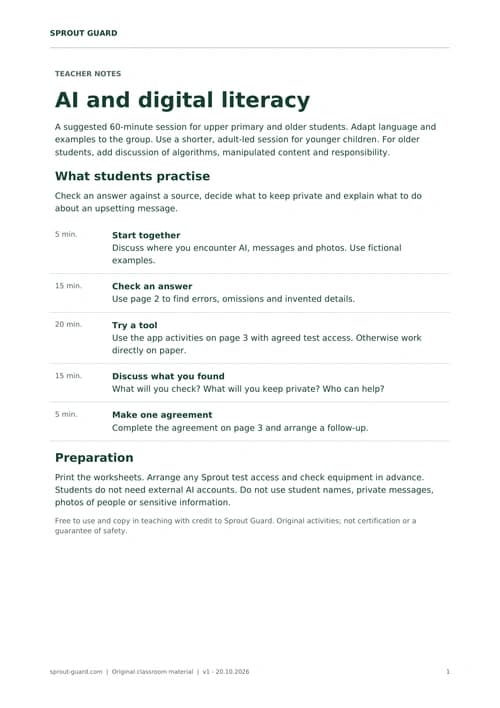
Free worksheets, teacher notes, a fact-check activity and a digital agreement. No AI accounts or app access needed.
Test access is arranged before the visit. We check the equipment and choose a shared demo or small-group activities. If access is not ready, we use the worksheets without apps.
We use only fictional messages and practice images without people or private details. The web apps are in development and do not replace adult judgement.
Explore the appsView app statusWe adapt sessions for primary and secondary schools, boarding schools, folk high schools and youth education. We also offer talks for parents and staff. Younger children work through short activities with an adult.
No. The sample session and worksheets work without an account with an external AI service. A teacher can show examples on a shared screen.
Yes. We can use the web apps in an agreed test session once access is ready. The apps are still in development. We arrange equipment and a guided try-out before the visit, using fictional information only.
Tell us about your audience, location and the visit you have in mind. You receive the price and practical details before deciding. Apps and materials are free; visits may have a cost.
Content, length and price are agreed with you.
Tell us about your group and what you have in mind. We agree the content, duration, price and practical arrangements with you.
An enquiry is not a confirmed booking.